
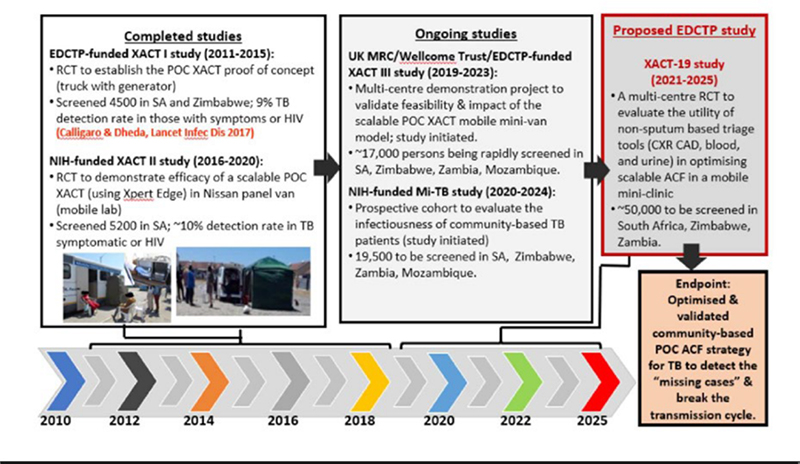
By 2017, through the EDCTP-funded XACT I study, we solved the impasse of rapid POC diagnosis by showing that molecular Xpert-based community-based screening was effective in identifying missing TB cases in the peri-urban ‘slums’ of Cape Town and Harare using a mini-truck with a generator.

However, such an approach was neither broadly affordable nor scalable. We therefore derived a scalable model using portable battery-operated Xpert Edge installed within low-cost (< US$ 15 000) Nissan panel van manned by two health care workers (thus making the ACF model affordable and scalable). This completed study, XACT II, screened over 5 000 participants in the community. The model worked well and was more effective than smear microscopy.